commits
| 2026-07-19 | README.md: Reference recording of the talk | Sören Tempel |
| 2026-07-15 | base64: Include exemplary bug as a source code comment | Sören Tempel |
| 2026-07-15 | slides.pdf: Initialize | Sören Tempel |
| 2026-07-13 | README.md: Improve wording | Sören Tempel |
| 2026-07-13 | README.md: HO26 → Hackover'26 | Sören Tempel |
Clone the repository to access all 11 commits.
An Introduction to Symbolic Execution
Material for an introduction to symbolic execution, a presentation at Hackover'26.
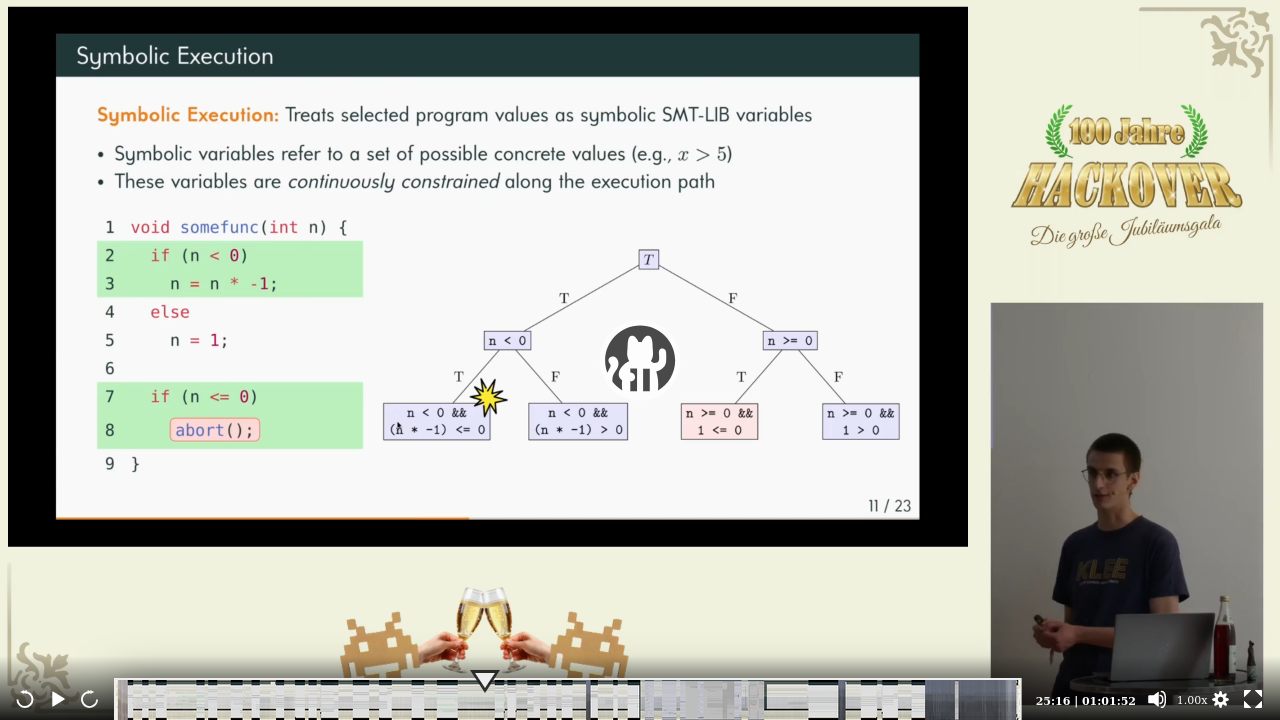
This repository includes the files required to experiment with the live demonstration from the presentation. Specifically, it includes the setup required to verify the Base64 implementation provided by the RIOT operating system. The original, unmodified source code is available on GitHub.
Usage
Ideally, use this repository with Guix:
$ guix time-machine -C channels.scm -- shell -m manifest.scm
Within the Guix shell run the following commands:
$ make sim
Alternatively, you can also try to use KLEE’s Docker image:
$ docker run --rm -v "$(pwd):/code" -it klee/klee
Within the container run:
$ cd /code
$ make sim
Tweaking the Example
The example uses a fixed-size input buffer, defaulting to 3 bytes.
The size can be configured through the INPUT_SIZE variable, for example:
$ INPUT_SIZE=2 make -B
For an input size of 3 bytes, 625 execution paths should be discovered. On my hardware, this takes around 2 minutes. Depending on the size, the number of execution paths, and the time required to discover them will vary.
Further, it is possible to experiment with various KLEE optimizations to speed up this example.
A technique particularly beneficial to this example is state merging.
To enable state merging, invoke make as follows:
$ CFLAGS=-DKLEE_STATE_MERGING make -B
This will merge multiple execution paths of getsymbol / getcode into a single conjugated SMT-LIB expression.
Thereby, increasing SMT-LIB query complexity but reducing the number of execution paths.
To play around with other optimizations, refer to the KLEE documentation.
More Information
The following material provides more background information:
- Symbolic Execution for Software Testing: Three Decades Later
- A Survey of Symbolic Execution Techniques
Further, the KLEE documentation includes additional practical examples: